
Air Duct Cleaning: Repair or Replace? How Bay Ridge Homeowners Decide
Most homeowners ask whether they should clean their ducts or replace them. That framing misses the real question. The decision is not clean versus replace – it’s whether your ductwork is structurally sound enough that cleaning is money well spent, or whether cleaning will just expose collapsed flex sections, failed duct board, and disconnected joints that were the problem all along. Cleaning deteriorating ductwork is like painting over rot. You’ve handled the surface without touching the structure beneath it. If you’d rather have a technician make that call for you, call (877) 938-5572.
Why “Clean or Replace” Is Usually the Wrong Question
Air duct cleaning in Bay Ridge gets sold as a maintenance item. And for a sound system, it is one. But when a system has structural problems, cleaning it first is often wasted money, or worse, it stirs up contamination that flows straight back out through the same gaps that let it in.
The better question is this: can this duct system hold its shape and keep its seals? If yes, clean it, then seal the seams so the contamination doesn’t return. If no, you’re looking at repair before cleaning, partial replacement, or a full rebuild. The cost gap between those paths is wide, and the wrong choice gets paid twice.
Here’s the order we work through when a homeowner asks. It applies whether you’re in a pre-war brownstone off Shore Road or a mid-century semi-detached house near Ridge Boulevard:
- Assess structure first. Look inside, not just at the grilles. Surface dust tells you nothing about whether the duct is intact.
- Identify the duct material. Galvanized steel, flex, and duct board each fail in different ways and at different ages.
- Find disconnected joints. A gap hidden in a wall cavity leaks air and dirt into the space behind your drywall.
- Decide the path. Clean and seal, partially replace, or rebuild. Then price it before work starts.
The rest of this guide walks through each step so you can follow a technician’s reasoning and spot a sales pitch dressed up as an inspection.
What Duct Condition Tells You That Surface Debris Doesn’t
Visible dust on a supply grille is not a diagnosis. A duct system can look filthy and be perfectly sound, or look clean at every register and be falling apart behind the walls. Structure is what decides whether cleaning is worth the money.
These are the indicators that make cleaning a poor first investment, and they show up regularly in older Bay Ridge building stock:
- Collapsed flex duct sections. Flex duct kinks and sags when it isn’t supported properly. A crushed run chokes airflow, and no amount of cleaning reopens it.
- Duct board delamination. The foil facing on duct board separates from the insulation over time. Once it lifts, fibers shed into the airstream and the board itself loses its seal.
- Disconnected joints in inaccessible cavities. A joint that has pulled apart inside a wall or ceiling cavity leaks conditioned air and draws dust in. You can’t clean your way past a gap.
- Rusted-through seams in old steel. Galvanized steel in pre-1960s homes can pit and rust at the seams, opening pinholes along the whole run.
- Contamination that returns after cleaning. If the same musty smell comes back within weeks, the source was never the dust – it was the breach.
Any one of these changes the plan. Cleaning a system with two or three is spending money to make a visible improvement that won’t hold.
How a Camera Inspection Changes the Math
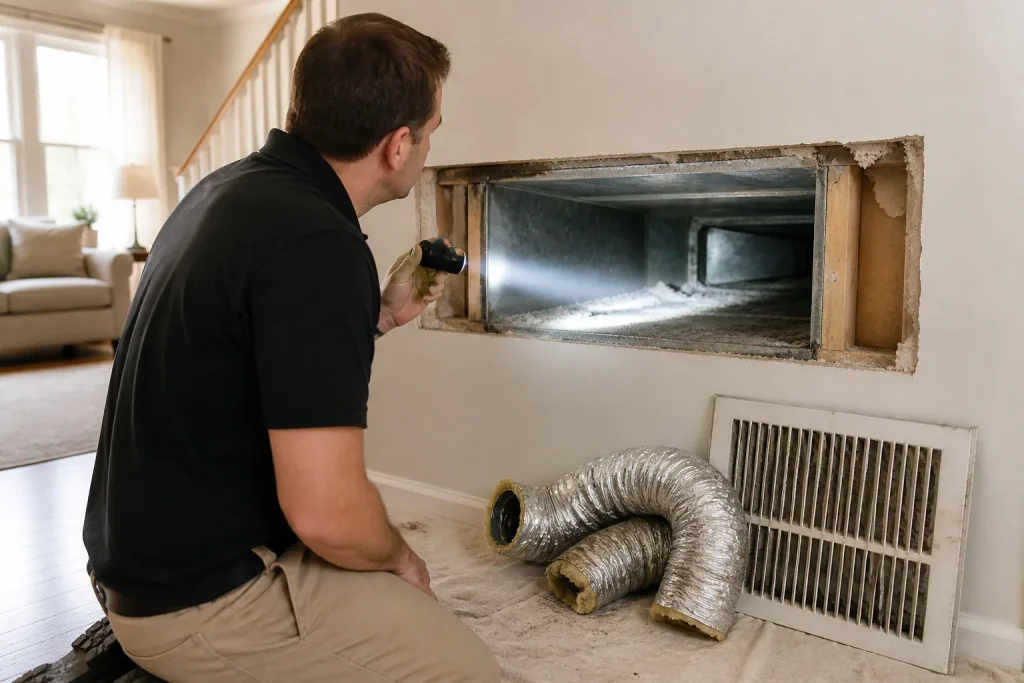
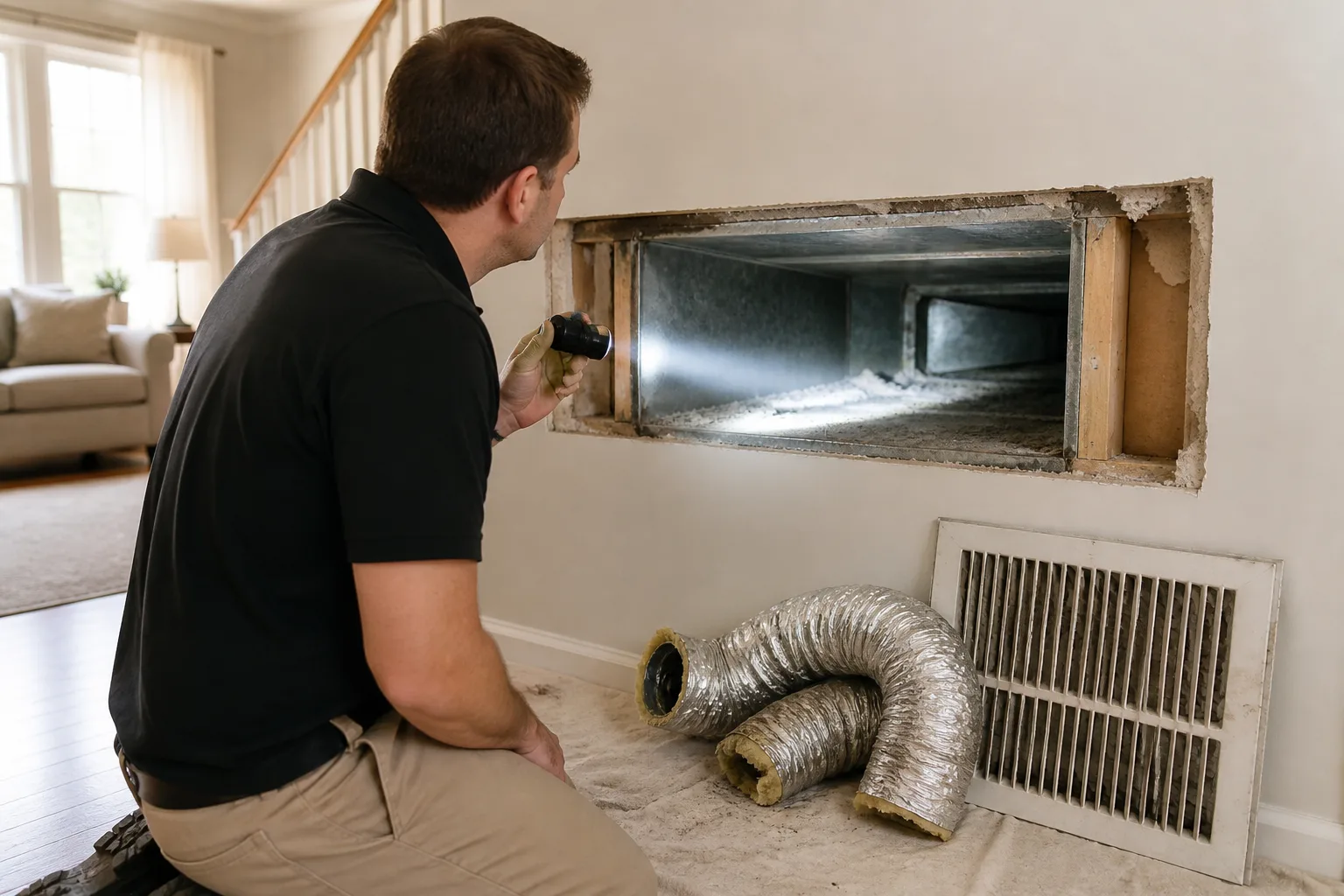
A camera inspection is what separates a real assessment from a guess. A technician feeds a camera through the trunk and branch runs and looks at the inside surface, the joints, the supports, and the transitions – not just the pile of debris sitting in the bottom of the duct.
What a camera reveals that surface inspection can’t:
- Whether flexible runs are actually connected. A joint separated by an inch inside a ceiling cavity is invisible from the register but obvious on camera.
- The true condition of duct board. Lifting facing and shedding fibers show up clearly and tell you whether the board needs replacing, not cleaning.
- Where the contamination originates. A single compromised return can be the source of a whole-house smell. The camera traces it back.
- Whether a partial repair is possible. Sometimes one failed branch or transition is the whole problem. Replacing that section and then cleaning is far cheaper than a rebuild.
During cleaning, proper containment matters as much as the camera. Professional-grade equipment – the Rotobrush and Nikro rotary brush and vacuum systems used by certified duct cleaning technicians, plus Abatement Technologies air filtration to capture dislodged debris rather than recirculate it – keeps what the camera finds from ending up in your living room. A shop vac and good intentions are not the same job.
The Economics: Partial Replacement vs. Full Rebuild
Once you know the structural condition, the cost comparison gets concrete. Partial replacement plus cleaning wins when the failure is localized. A full rebuild is the only logical path when the damage runs through the whole system.
When partial replacement makes sense:
- One or two failed branches, transitions, or collapsed flex runs, with the rest of the system sound.
- Intact galvanized trunk with a few compromised branch connections.
- Localized duct board failure where the surrounding board is still sealed and firm.
In these cases, you replace the failed sections, seal the seams, then clean the whole system. That’s the clean-then-seal approach done in the right order, and it’s usually the cheaper of the two paths.
When a full rebuild is the honest answer:
- Delamination or failure throughout most of the duct board.
- Multiple disconnected joints spread across inaccessible cavities.
- A galvanized system so rusted and leaky that sealing every seam costs more than replacing the run.
We don’t hand out prices from a menu here. Every job is quoted per system from a written estimate after inspection, because the difference between “replace one branch” and “rebuild the trunk” is everything. What we can say is that the written estimate sets the final price, and you agree to it before any work starts.
Bay Ridge Structural Factors: Steel, Flex, and How Each Ages
Bay Ridge’s housing stock shapes this decision more than most homeowners realize. The material in your walls depends on when your home was built and what was done to it since.
Original galvanized steel in pre-1960s homes. Many of the area’s older houses and buildings still run their original galvanized trunk lines. Steel is durable, but seams rust and pit over decades, and a leaky seam in a Bay Ridge basement or wall cavity draws in dust and moisture. A sound galvanized system cleans up beautifully. A rusted-through one needs repair first.
Flex duct retrofits from oil-to-gas conversions in the 1980s. A lot of homes had their ductwork reworked when heating systems were converted. Flex was the fast, inexpensive choice, and it’s now decades old. Flex kinks, sags, and separates at the collars more than rigid duct does – and it’s the retrofit runs that most often turn up collapsed on camera.
How the climate plays in. Bay Ridge summers are humid, and humid air in a poorly sealed system encourages the mold and musty smells homeowners notice first. Duct board is especially vulnerable – once its facing lifts, moisture works into the insulation. The lesson is the same across all three materials: the seal is the defense, and a leaky system gets worse faster in a humid climate.
Our technicians have up to 15 years of experience reading these systems, and the pattern is consistent. Material and era tell you where to look first.
Getting an Honest Assessment: What to Ask
A credible technician documents what they find and shows you. A sales-driven recommendation arrives before any camera goes in. The difference is usually visible in the first ten minutes.
What a credible inspection includes:
- Camera footage of the trunk, branches, and transitions – offered, not just mentioned.
- Notes on duct material, joint condition, and any flex sections, with the failed areas identified.
- A written estimate that separates repair from cleaning, so you can see the cost of each.
- Before-and-after photos of your own ducts, so you can see the work that was done.
Questions that separate the two:
- “Can I see the camera footage of the problem area?” An honest technician will show it. A pitch won’t have it.
- “What exactly fails here, and what does fixing it cost?” Vague answers mean a vague plan.
- “Is the price per system, or per vent?” You want one flat price per system, agreed before work begins – not a per-vent total that grows as the job goes.
- “What changes if I clean first and repair later?” If the answer is “nothing,” be skeptical.
If inspection turns up failed duct board or a compromised seal, what you want next is sealing and air quality work from the same people who found the problem – Honeywell and Aprilaire products for filtration and humidity control, and Guardsman treatments where sanitizing is needed. That keeps one accountable plan instead of three vendors pointing at each other.
When to call a pro: if you smell something musty that returns after cleaning, if a room never gets enough airflow, if you’ve just finished a renovation, or if your system is decades old and you’ve never had it inspected. air duct cleaning is the right first move on a sound system, and a camera inspection is what tells you whether yours is sound. If your dryer vent hasn’t been done in years, dryer vent cleaning addresses one of the leading causes of residential fires, and HVAC cleaning rounds out the system-wide picture.
Related services in Bay Ridge: we handle the full air pathway, from Air Duct Cleaning Bay Ridge through duct repair and sealing to air quality and sanitizing.
The Bottom Line
For most Bay Ridge homeowners, the answer comes down to structure, not dust. If your duct system is intact, cleaning and then sealing it is money well spent. If it has collapsed flex, delaminated duct board, or disconnected joints, repair has to come first, and sometimes a full rebuild is the honest path. The way to know is a camera inspection and a written estimate that separates repair from cleaning.
If the inspection turns up a problem, clean-then-seal in that order is what keeps contamination from coming right back. And a technician who can show you the footage and quote you one flat price per system has earned the call.
If you’re in Bay Ridge and need help, Air Duct Cleaning Bay Ridge offers free estimates – call (877) 938-5572. We answer 24/7. Fast dispatch from 7am to 7pm, Sunday through Friday.
Frequently Asked Questions
Air duct cleaning in Bay Ridge is priced per system, not per vent, and the final price comes from a written estimate after inspection. We don’t quote a teaser number, because a sound system and a system with failed sections are different jobs. Call (877) 938-5572 for an exact quote – estimates are free.
Cheap quotes are usually per-vent pricing that grows once the technician is on site, or they skip the camera inspection and clean without addressing structural failures. A low coupon price can become a far larger invoice, and cleaning a broken system doesn’t fix it. A flat price per system, agreed before work starts, is the honest version. Call (877) 938-5572 for an estimate that holds.
You see it. A credible job includes before-and-after photos of your own ducts and camera footage of what was found. We document the work so you can verify it rather than take our word for it. Call (877) 938-5572 to book an inspection.
Duct cleaning is not a fixed-schedule item. A sound system with a sealed, well-filtered setup usually needs it far less often than a leaky one that keeps pulling dust in. If you notice a musty smell returning after cleaning, the schedule isn’t the problem – the seal is. Call (877) 938-5572 and we’ll tell you honestly whether you need it now.
Written by the team at Air Duct Cleaning Bay Ridge.
Need Air Duct Cleaning Help?
Call Air Duct Cleaning Bay Ridge - the local pro we connect you with is licensed and insured, with free written estimates in Bay Ridge.
(877) 938-5572