
Top Signs You Need Air Duct Cleaning Service – Don’t Ignore These
Dust on your registers is a lagging indicator. By the time it’s visible, a fair amount of accumulation has already happened upstream, in the runs and plenum you never see. The earlier signs are subtler, and in Bay Ridge they’re specific to how these homes are built: attached rowhouses, converted multi-families, basements that sit partway below grade, and heating systems that have changed fuel source more than once over the decades. If you’d rather have someone look instead of guessing, call (877) 938-5572 for a free estimate.
Key Takeaways
- Read your registers as diagnostic tools, not just a cue to vacuum. Pattern, color and location of dust tell you where the problem starts.
- Odor in an attached Bay Ridge rowhouse often points to shared wall cavities and moisture, not just dirty duct interiors.
- Longer HVAC run times, uneven room temperatures and rising utility bills are systemic signs worth investigating before they become expensive.
- Renovation dust, appliance swaps and pest activity are post-event triggers most homeowners underestimate.
- “Clean enough” and “actually clean” are different things. Grilles can look fine while return plenums hold years of debris.
What do your registers actually tell you?
A register grille is a window into the system. What settles on it, and how, tells a technician where contamination likely originates. Normal dust accumulation is even, gray, and builds slowly over months. It wipes away clean and comes back at the same rate. That’s ordinary household life.
Active contamination looks different. Watch for these patterns:
- Dark staining around the grille edges. This often means air is escaping past a poor seal, pulling dust from the wall cavity into the airstream. In Bay Ridge rowhouses, that cavity is frequently shared with a neighboring unit.
- Uneven dust across registers in the same room. One grille dark, one clean usually points to a pressure imbalance or a disconnected run, not a cleaning problem.
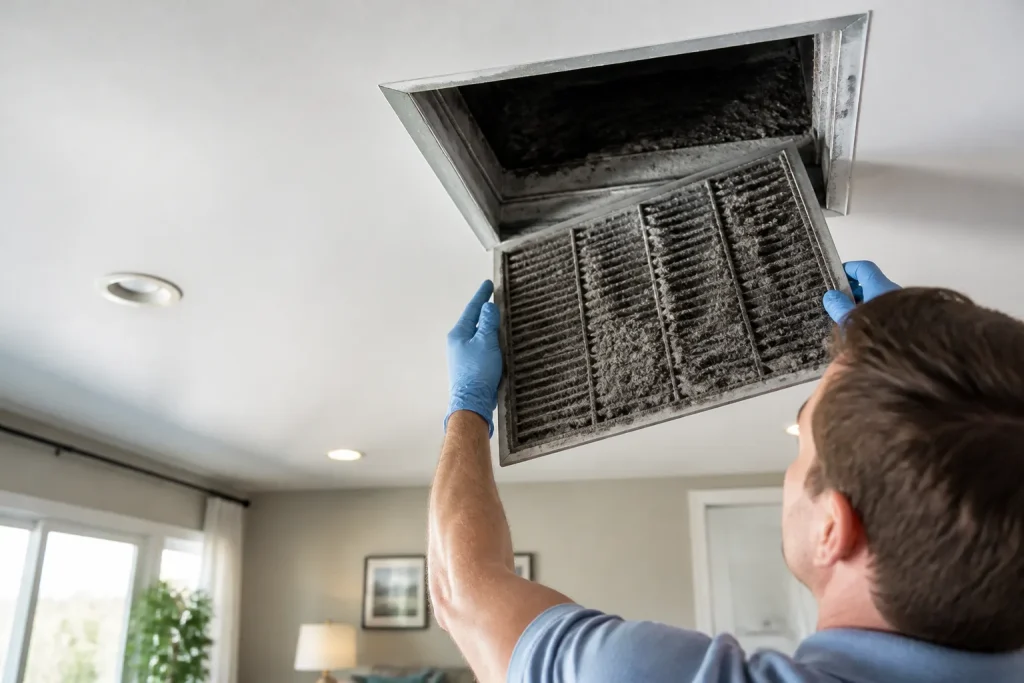
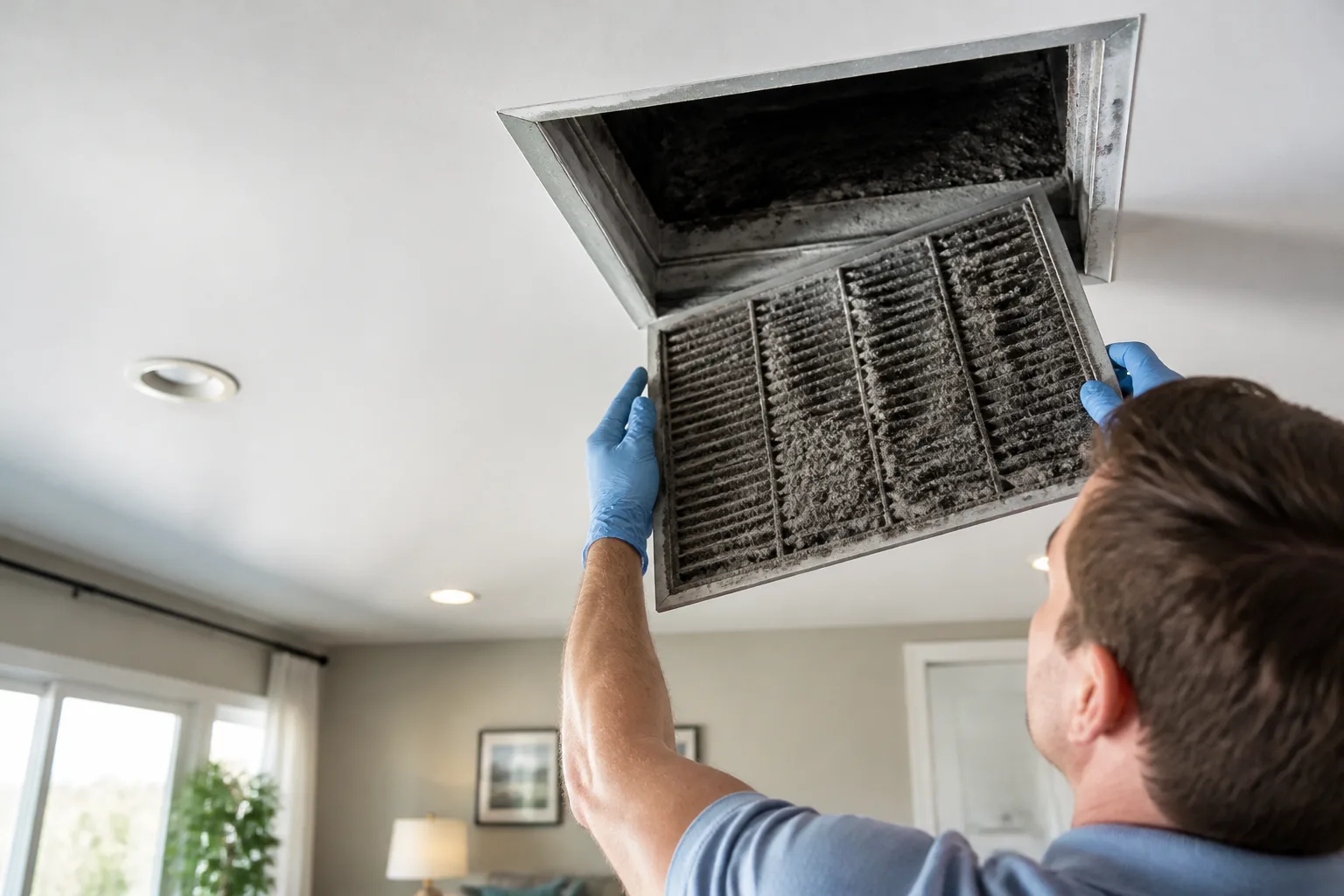
- Fuzzy or fibrous debris on the grille face. That’s debris the filter didn’t catch, which means the return side is loading up.
- Black or gray streaking on ceiling paint near supply vents. Airborne particles are depositing as they leave the duct, a sign of volume the system wasn’t designed to move.
A register that looks fine but sits in a room with a persistent musty smell is still telling you something. Grilles only show what reaches them. Plenty of contamination never does.
Which Bay Ridge-specific signs should you watch for?
Bay Ridge housing stock creates duct problems you won’t read about in a generic checklist. The neighborhood’s attached rowhouses and converted multi-families often have duct systems that pass through or alongside shared wall cavities. That geometry matters.
- Odor that appears in one unit and not the next. In attached housing, a musty or smoky smell confined to one room often traces back to a wall cavity or a return chase that’s picking up air from an adjacent space. Cleaning the ducts without addressing the cavity source is temporary at best.
- Moisture at basement duct runs. Many Bay Ridge homes have partial below-grade levels where ductwork sits in cooler, damper air. Condensation on uninsulated runs feeds biological growth that a shop vac can’t remove and a filter can’t stop.
- Fuel source history. Homes that converted from oil to gas, or from gravity furnaces to forced air, sometimes kept original duct runs that were never sized or sealed for the new system. Those runs collect debris differently and leak more.
- Return plenum in a closet or chase. Common in older conversions, and rarely cleaned because it’s out of sight.
If any of these sound familiar, it’s worth a look. Call (877) 938-5572 and we’ll tell you what we’d check first.
What does HVAC performance degradation actually look like?
Homeowners tend to notice duct problems through their HVAC system before they notice the ducts themselves. That’s because restricted or leaky ductwork makes the equipment work harder for the same result. The signs are behavioral, not visual.
- Longer run times. The system cycles on and stays on longer to reach the setpoint. If your runtime has crept up season over season, restricted airflow is one likely cause.
- Uneven room temperatures. A room that’s always a few degrees off, especially one at the end of a long run, often has a partially blocked or leaky branch.
- Rising utility costs without a rate change. Compare the same months year over year rather than month to month. A steady climb in an otherwise unchanged home is worth investigating.
- Weak airflow at specific registers. Hold your hand at each supply. Noticeable differences between rooms point to a distribution problem, which cleaning plus sealing can address.
- Frequent filter changes. If filters load up faster than they used to, the system is moving more particulate than it should. That particulate is coming from somewhere.
These are systemic indicators, not cosmetic ones. Cleaning alone helps, but if the ducts leak, contamination re-enters. That’s why we pair cleaning with sealing rather than treating them as separate visits.
Which post-event triggers do homeowners underestimate?
Some of the clearest reasons to clean ducts have nothing to do with slow buildup. They’re events, and the contamination they leave behind is concentrated and immediate.
- Renovation and drywall dust. Fine gypsum and joint compound dust travels further than sawdust and settles deep into runs. A renovation in one room can load the entire system. If your contractor sealed the registers, that helps, but it rarely catches everything.
- Appliance replacements. Swapping a water heater, furnace or dryer changes airflow and can dislodge debris that had settled quietly for years.
- Pest activity in wall cavities. Rodents and insects move through the same voids ductwork passes through. Nesting material and droppings near a duct run are a legitimate reason to clean and sanitize rather than just vacuum.
- Water intrusion. A roof leak, a basement flood or a slow plumbing drip that reaches duct insulation creates a moisture problem that doesn’t resolve on its own.
We use Abatement Technologies filtration equipment during service specifically to capture dislodged contaminants rather than recirculate them through your home. That matters most on jobs triggered by an event, when the debris volume is high.
What’s the difference between “clean enough” and “actually clean”?
This is the part most homeowners can’t see, and it’s the reason a cheap cleaning can look identical to a thorough one from the hallway. A register grille can appear spotless while the return plenum behind it holds years of accumulated debris. Grilles get wiped. Plenums don’t.
What a proper job involves:
- Source removal, not surface wiping. Rotary brush and high-powered vacuum equipment, like the Rotobrush and Nikro systems we use, agitate and extract debris from the duct interior along its full length.
- Containment throughout. Negative pressure keeps dislodged material from spreading into living space.
- Before-and-after photos. You should see what came out, not just be told it did.
- Return side included. Many budget jobs skip the return plenum because it’s harder to reach.
- Sealing after cleaning. Clean ducts, then seal them. Otherwise you’re back where you started in a couple of years.
This is where equipment separates vendors. Consumer-grade vacuums can’t generate the airflow a real duct system needs, and improvised tools can damage flex duct. Professional-grade equipment, not improvised tools, is the baseline.
When to call a pro
Some signs you can address yourself: replace the filter, vacuum the grilles, check that no furniture is blocking returns. Others need eyes inside the system. If you’re seeing dark staining at grille edges, smelling something musty that won’t go away, noticing uneven room temperatures, or you’ve just finished a renovation or dealt with pest activity, it’s time to have the ducts inspected. Electrical and gas components of your HVAC system should always be handled by a trained professional, and duct cleaning is no different: it requires equipment and containment that DIY can’t replicate safely.
Related services in Bay Ridge: if you’re already scheduling air duct cleaning, it’s a sensible moment to add dryer vent cleaning, which addresses a leading cause of residential fires that HVAC-only contractors often overlook, and HVAC cleaning for the equipment side of the system.
The Bottom Line
The signs worth acting on are rarely the obvious ones. Read your registers as diagnostics, pay attention to odor and moisture patterns specific to attached Bay Ridge housing, watch how your HVAC behaves rather than just how it looks, and treat renovations, appliance swaps and pest activity as reasons to check the system. When you do clean, clean the full air pathway, seal what leaks, and ask for before-and-after photos so you know the work was done. If you’re in Bay Ridge and need help, Air Duct Cleaning Bay Ridge offers free estimates. Call (877) 938-5572. We answer 24/7. Fast dispatch from 7am to 7pm, Sunday through Friday.
Frequently Asked Questions
Most homes don’t need a fixed schedule. The honest answer is that cleaning is driven by conditions, not the calendar: renovation dust, moisture, pest activity, visible debris at the source, or persistent odor. A home with none of those can go considerably longer than the “every few years” figure you’ll see quoted. If you’re unsure, an inspection settles it. Call (877) 938-5572 for a free estimate.
Yes. Grilles are the easiest part of the system to wipe, and they often look fine while return plenums and the runs behind them hold years of debris. That’s why a visual check of the grille tells you very little. The useful check is inside the system, ideally documented with before-and-after photos. Call (877) 938-5572 to schedule an inspection.
Often, yes, but for reasons specific to the housing. Attached rowhouses and converted multi-families frequently have ducts passing alongside shared wall cavities, partial basement runs exposed to damp air, and original ductwork that was never sized for the current system. Cleaning plus sealing addresses those conditions. Cleaning alone on a leaky system just resets the clock. Call (877) 938-5572 and we’ll walk through what to check first.
Cleaning removes debris. Sanitizing treats what’s left on the surfaces after cleaning, which matters most when there’s been moisture, pest activity or an odor source. We incorporate Guardsman-brand products into sanitizing treatments, and we can supply and install Honeywell or Aprilaire filtration and humidity products in the same visit so the system does a better job of keeping itself clean. Call (877) 938-5572 for a free estimate.
Written by the team at Air Duct Cleaning Bay Ridge.
Need Air Duct Cleaning Help?
Call Air Duct Cleaning Bay Ridge - the local pro we connect you with is licensed and insured, with free written estimates in Bay Ridge.
(877) 938-5572